Make Modern Issue 73 is here!
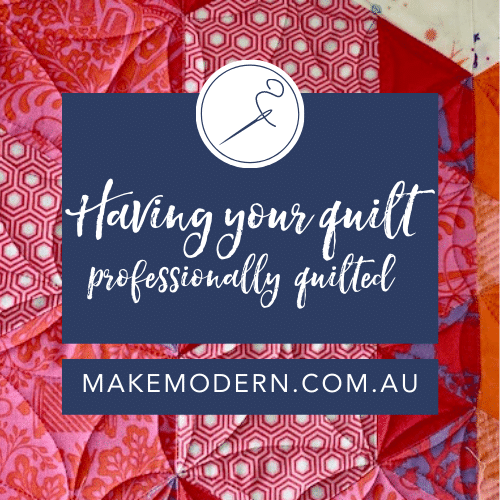
Red modern quilt with superimposed text having your quilt professionally quilted

Having Your Quilt Professionally Quilted

Tips

Posted on 22nd March 2023

Award-winning longarm quilter Michele Mason answers five frequently asked questions about approaching a professional quilter...
By Michele Mason

Why not treat yourself to a subscription?
Subscribe now and dive into the latest issue!

Subscribe

You’ve chosen your fabric colours, carefully made your quilt, lovingly pressing all your seams along the way. You get to the end of the pattern, and it says, “quilt as desired”. What does that mean? What are you supposed to do? Anyone who has wrestled a quilt through the throat of their sewing machine will tell you it is not for the faint-of-heart. Not to mention basting it all in the first place. Surely there is an alternative.

There is.

Many amazing professional quilters are available who will take your top, batting and backing, work their magic, and quilt it for you. Taking your quilt to a professional quilter means that you can have your patchwork top transformed into a texture-rich, fabulous quilt. As a professional quilter, I have quilted hundreds, if not over a thousand quilts over the years. I would like to address some of the reservations you might have with approaching a professional quilter to quilt for you.

Longarm quilting machine quilting a modern rainbow quilt

1. What is a professional quilter, and what do they do?

A professional quilter is someone who has invested in equipment, training and has the expertise to quilt a wide variety of quilts. Often, quilters will use a longarm quilting machine. This is a giant sewing machine that has a large throat space and is set on a carriage on a long table. The quilt is attached to rollers and the machine is guided by hand or by computerised motors, to stitch a design through all three layers of the quilt. Some quilters use a sit-down machine and free motion the quilt without moving the machine, but this is less common.

There are generally two types of quilting offered, edge-to-edge and custom quilting. Edge-to-edge is when a design is repeatedly worked over the quilt to give a consistent overall texture. An edge-to-edge design should be chosen to enhance the quilt, but the individual pieces of the quilt will not be quilted around specifically. Custom quilting is when the patchwork design is enhanced by applying designs in specific areas, background fill is often added, and blocks almost always have stitching ‘in the ditch’.

Grey, white and pink wavy quilt with complex graffiti quilting

2. Why and when should I use a professional quilter?

There are many scenarios where you might want to hire a professional quilter, and I will outline some for you. Everyone is different, and the simplest answer might be that you aren’t interested in quilting, as it requires an additional skill set to patchwork. If you have a special quilt that you have made and you want the very best result, a pro quilter can help you by using their experience to guide you whether you choose an edge-to-edge or custom. Due to the investment in our equipment and training, we can deliver a great result that will suit your taste, vision, and budget. You may have made a quilt for a special gift and would like special quilting. You might see an amazing quilt on Instagram and want to replicate it, complete with that fabulous edge-to-edge design (hint: check the hashtags for the design name). Basting a quilt might be difficult or just plain boring, and did you know you don’t even have to baste your quilt when you take it to your quilter? How cool is that?

Modern half-square triangle quilt in blues, greens and greys with wavy quilting

3. How much does it cost, and is it good value?

Pricing can vary depending on the quilter. This can be related to the quilter and how busy they are, how much experience they have, what area they are located, and possibly relative to the equipment they have. The thing I have found is that the relationship you develop with your quilter can be more important than the price. Of course, you should find a quilter that aligns with your budget, however, the value of trusting your quilter and having them go above and beyond for you is priceless. A quilter can save you hours of work, deliver a consistent result, and save you the thousands of hours of practice you need to gain the skill set they are offering to you.

Modern hexagon quilt in reds and pinks with curved quilting

4. How do I prepare my quilt?

Perhaps you have decided to try having your quilt professionally quilted. The best person you can ask about preparation requirements is your quilter. Better still, they should be proactively giving them to you so that you can work together to get the best result for your quilt. Generally, quilters using a longarm require your backings to be 8-10 inches longer and wider than your quilt top. They also prefer them to be squared up, at a minimum the top and bottom edge should be parallel. This allows your quilter to attach the backing to their quilting frame without distortion. Most quilters will advise you about batting, and many sell their favourite batting so you don’t need to supply it along with your quilt top. Batting also needs to be about 8-10 inches longer and wider than your quilt top. Your quilter will ask you about your quilt, and help you choose a quilting design and thread to give your quilt the best possible finish. Some quilters also offer trimming and binding services.

Modern scrappy curved quilt in white, orange, green and aqua heavily quilted

5. How do I find and hire a professional quilter?

There are many ways to find a professional quilter. Ask your quilt friends who they use. Quilting publications such as Make Modern often have adverts from quilters who are available. You can find a quilter on social media, or you can google quilting services in your area. There are professional machine quilting associations such as Machine Quilting Academy and Longarm League that have member lists of quilters who are dedicated to ongoing learning and training, and your guild also may keep a list of quilters local to you. Many quilters accept quilts by mail, and this removes many geographic boundaries to accessing a quilter. However, it makes sense to find a quilter in your country, due to international postage, but if you really like a quilter’s style, ask if they will post to you – they probably will. When you are choosing a quilter, ask them lots of questions. Don’t be shy. I am always happy to answer anything about my quilting experience and your quilt questions, so please don’t feel afraid to ask. Your quilter wants to do the best they can for your quilt, and for you to be thrilled with your finished quilt.

Small selection of solid fabrics in greens, pinks and oranges

About the author:

Michele Mason lives on the beautiful Sapphire coast, in far south-east New South Wales, Australia. She began quilting in 2004 in Sydney as Michele Turner of Pinetree Cottage Quilting and has won numerous awards for her quilting of her own quilts and for her clients. Now under the new name of MishMash Quilts, Michele offers freehand custom and computerised edge-to-edge quilting to clients all over Australia, as well as an easy shopping experience for a wide range of modern quilting solid fabrics on her website at www.mishmashquilts.com.au


Latest Posts

Subscribe To Make Modern Magazine Today!

Subscribe